
A Cello Conversation with Bach
September 9, 2024
By Lawrence Toppman
Ruth Friedberg, my first music professor 52 years ago, called music a conversation between the composer and ourselves. That’s often not true: Berlioz wouldn’t care what anyone thought, and I suspect Beethoven would care only so he could argue with us. But listening to J.S. Bach, especially in his chamber music, really is like hearing him speak with you rather than at you. Cellist Guy Fishman proved that Saturday at Holy Comforter Episcopal Church.
Because of a prior engagement, I didn’t catch the three solo cello suites in his afternoon performance. But the other three on the evening bill – 5, 6 and 1, in that order – revealed Bach whispering to us, storming at us, praying with us, kidding us, nudging and even urging us to dance. I all but opened my mouth to ask, “Hey, JSB: What’s a snippet from “Sheep May Safely Graze” doing in here?”
The divided marathon didn’t officially kick off Bach Akademie Charlotte’s 2024-2025 season, which begins in October with a concert titled “The Lutheran Vespers: Re-Imagined” and ends with the nine-day Charlotte Bach Festival in June. Nor did it officially commemorate the 200th anniversary of the publication of these suites in Paris, where they were billed as etudes. (“Try these learning exercises, students!” This is like offering a Maserati to a third-year driver.)
But the concert gave us a chance to hear Fishman, principal cellist of the Haydn + Handel Society in Boston and the big summer festival here, in the first great set of solo cello pieces in the Western canon. He lectured a bit and then took us from the emotional darkness of suite 5 to the buoyancy of suite 6 to the mellowness of suite 1.
Not that each grouping of 20 to 25 minutes sticks to one mood, of course. You can’t perform a gentle gigue in the minor-key fifth suite the same way you would its introspective sarabande, which French cellist Paul Tortelier once called “an extension of silence.” (Yo-Yo Ma played it at the World Trade Center site one year after 9/11 to commemorate the dead.)
Though every movement except the preludes bears the name of an antique dance – allemande, gavotte and so forth – Bach doesn’t adhere to their rhythms strictly or, sometimes, detectably. He can follow the lilting prelude to the first suite with a jaunty allemande and a fleet-footed courante that really does seem to be running. (That’s what the word means in French. The movement titles are in that language, as the structures are based on French suites.)
Fishman switched from a four-string cello to one with five strings to play the sixth suite, and that’s where he took the most audacious chances. He ground away like a hurdy-gurdy in the prelude, opted for slower tempos than I’m used to in the middle portions, then took an unusual view of the gavotte: His heavy accents summoned a vision not of grace in a salon but thick-booted peasants stomping in a saloon.
Maybe Bach, an earthy guy, would have smiled. He never had any idea the public would listen to these pieces, anyway; he wrote them, probably between 1717 and 1723, for private use. As noted, they sat around for 74 years after his death in 1750 before anybody thought them worth publishing. Two hundred years later, they’re the most important solo cello pieces on record.
The late Dr. Friedberg also said, “No two performers will ever play great music the same way.” She shared Pablo Casals’ immortal recording of these suites, and I have since heard Ma, Pierre Fournier, Mstislav Rostropovich and many others. Sure enough: Guy Fishman made me hear them anew Saturday night.
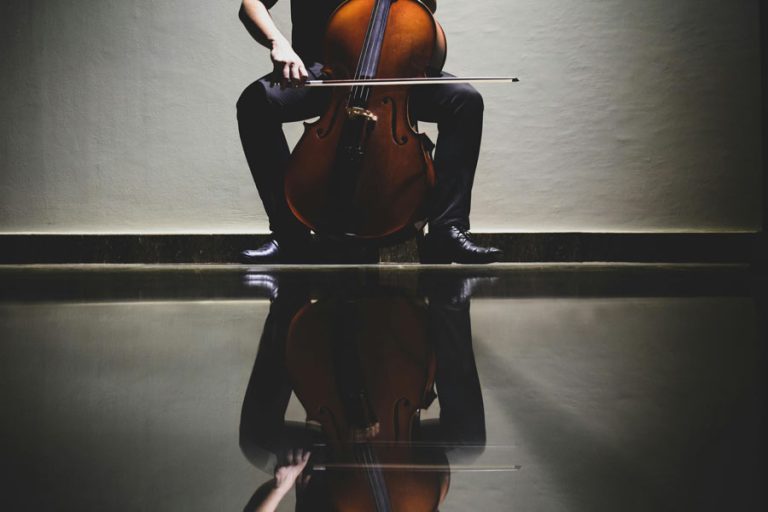
Photo by Eleazar Ceballos.